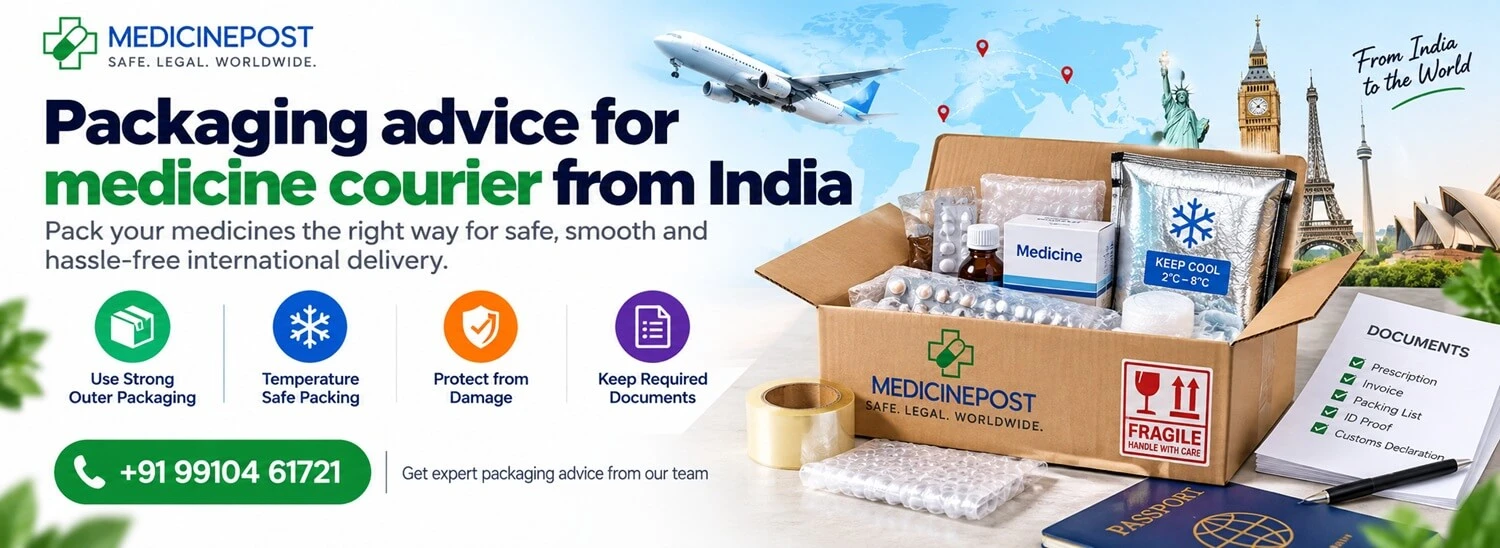
Packaging advice for medicine courier from India
How to pack prescription, Ayurvedic, liquid, and cold-chain medicines so they clear customs and arrive intact — whether you are sending to the USA, UK, Canada, UAE, Australia, or 200+ other countries.
Why proper packaging matters
Wrong packing causes breakage, temperature spoilage, customs delays, and voided insurance. Destination agencies — US FDA, UK MHRA, Health Canada, Australia TGA, and UAE DHA — expect labelled original packs they can inspect without destroying the medicine. Follow our step-by-step guide to send medicines abroad, then get instant courier charges.
Protect the medicine
Shock, moisture, and heat control from India pickup to doorstep abroad.
Clear customs
Readable labels and documents outside the carton speed inspection.
Keep insurance valid
Carrier-standard packing is required if a claim is ever needed.
Step-by-step: pack medicines safely
Follow this sequence for every international medicine parcel from India.
-
1
Sort medicines by type
Group tablets, liquids, injectables, and cold-chain items separately so each gets the right protection.
-
2
Keep original sealed packs
Leave medicines in original bottles or blister packs with labels, batch numbers, and expiry dates intact.
-
3
Cushion and seal
Wrap fragile items, fill empty space, double-bag liquids, and use a rigid corrugated carton.
-
4
Set the cold chain
For insulin, vaccines, or biologics, use insulated packaging with pre-conditioned gel packs that will not freeze the medicine.
-
5
Attach documents outside
Place prescription, pharmacy bill, KYC, and customs declaration in a waterproof pouch on the carton exterior.
-
6
Seal, label, and inspect
Use tamper-evident tape, confirm labels match the invoice, and check box strength before pickup.
Packaging by medicine type
Narcotics and NDPS-controlled substances cannot be packed or shipped. Country restrictions differ — check the banned medicines list for Canada, USA import rules, or ask us before you pack.
-
Prescription medicines
Original Rx, sealed packs, discreet outer carton, and a matching pharmacy invoice.
-
OTC medicines
Standard cushioning plus destination-country OTC rules — some countries restrict codeine or melatonin.
-
Ayurvedic & herbal
Airtight packs, ingredient list, and lab notes where required. Keep powders dry.
-
Homeopathic
Protect from heat, strong odours, and mixing different potencies in one pouch.
-
Cancer & critical care
Shock-absorbent inner packs, temperature control if required, and optional insurance.
-
Injectables & vials
Individual cavities, no glass-on-glass contact, and extra cushioning on all sides.
-
Insulin & vaccines
Validated 2°C–8°C packaging, gel packs buffered from vials, and a temperature indicator.
-
Vitamins & supplements
Light- and moisture-proof wrap. Check destination-country rules for herbal extracts.
Cold-chain packaging (insulin, vaccines, biologics)
Maintain 2°C–8°C without freezing. Over-cooling in Canadian winter is as damaging as Gulf heat.
- 1Use EPS or VIP insulated boxes sized for the full transit window (typically 3–9 days).
- 2Pre-condition gel packs; place a thermal buffer so packs never sit on vials.
- 3Add a temperature indicator. Do not freeze insulin.
Need cold-chain to Canada, USA, UAE, or Australia? Tell us the medicine name — we pack to climate and courier rules.
Packaging materials we use
Lightweight where possible because volumetric weight affects medicine courier charges from India.
| Material | How it is used |
|---|---|
| Original bottles / blister packs | Primary pack — never decant tablets or syrups into unlabelled containers. |
| Bubble wrap & foam | 2–3 inches of cushioning around glass, vials, and bottles. |
| Airtight poly bags | Secondary moisture and leak barrier, especially for liquids and powders. |
| Absorbent pads | Inside liquid bags so a leak does not wet the rest of the carton. |
| Insulated box + gel packs | Cold-chain only. Size gel packs to transit time and the destination country's climate. |
| Double-wall corrugated box | Outer carton that can survive stacking and courier handling. |
| Tamper-evident tape | Shows if the box was opened in transit. |
| Waterproof document pouch | Prescription, invoice, KYC, and customs form on the outside. |
Climate and country packing notes
The packing method is the same worldwide. Climate, inspection style, and last-mile rules change. Open the country page for charges, tracking, and local compliance — then compare live rates.
-
 Medicine courier to USA
FDA personal-import labelling: keep original packs, Rx, and invoice accessible for inspection.
-
 Medicine courier to UK
MHRA personal-use shipments need clear labels and a matching prescription.
-
 Medicine courier to Canada
Winter freeze risk — buffer gel packs so insulin does not freeze. Health Canada labelling required.
-
 Medicine courier to UAE
High heat — extra insulation and enough gel packs for 3–7 day transit through the Gulf.
-
 Medicine courier to Australia
TGA / biosecurity may open parcels. Do not over-seal inner layers; keep documents easy to reach.
-
 Medicine courier to Germany
EU inspection prefers original packs and a matching invoice; keep documents on the carton exterior.
-
 Medicine courier to Singapore
HSA personal-import rules: labelled originals, modest personal-use quantity, and a clear prescription.
-
 Medicine courier to New Zealand
Longer transit — size gel packs for 7–10 days and Medsafe labelling on original packs.
Documents: attach them on the outside
Customs must read paperwork without opening sealed medicine packs.
- 1. Prescription
Stamped Indian Rx in a clear sleeve.
- 2. Pharmacy bill
Names, quantity, batch, and expiry matching the pack.
- 3. Sender KYC
Aadhaar, PAN, or passport copy.
- 4. Customs declaration
MedicinePost prepares this in a waterproof pouch.
Have documents ready, then get your packing and courier quote. Country-specific checklists: USA, UK, Canada, Germany.
Packaging mistakes to avoid
- Leaving empty space so bottles rattle and crack
- Using thin single-wall boxes that crush in transit
- Putting all documents inside the carton (customs cannot open primary packs)
- Placing gel packs directly on insulin or vials (freeze damage)
- Over-packing gel packs for short winter routes
- Mismatched labels vs invoice / prescription
Courier packaging standards
MedicinePost packs once to the partner you choose — DHL, FedEx, UPS, or Aramex. You do not need a different DIY kit per courier. Compare partners on each country page, e.g. UPS for Canada or Aramex for UAE, then get live rates.
-

DHL. Medical Express guidelines for temperature-controlled and documented pharma parcels.
-

FedEx. Cold Chain Pak / approved thermal systems for 2°C–8°C medicines.
-

UPS. Temperature True-style validated packs — preferred for USA & Canada lanes.
-

Aramex. Healthcare specs for Gulf countries; heat-resistant outer cartons.
Weight optimisation without unsafe packing
- Prefer air-cellular wrap over heavy packing peanuts.
- Choose the smallest carton that still has 2–3 inches of cushioning.
- Consolidate household medicines in one shipment when destination-country rules allow.
- For parcels above 2 KG, per-kg rates apply — packing volume still affects the bill. Get per-kg charges for your country.
Final checklist before pickup
- Medicines in original sealed packs, within expiry
- Fragile items individually wrapped; liquids double-bagged
- Empty space filled; carton is rigid and not overstuffed
- Cold-chain pack activated only if the medicine needs 2°C–8°C
- Prescription, bill, KYC, and declaration in an external pouch
- Tamper-evident tape on all seams; labels match documents
Medicine courier from India to other countries
Same packing method, country-specific charges, transit time, and customs rules. Open a country page for rates, tracking, and banned-medicine notes — or get an instant quote.
Australia
 Bahrain
 Bangladesh
 Belgium
Canada
Belgium
Canada
 China
China
 France
Germany
France
Germany
 Hongkong
 Ireland
 Italy
Italy
 Kenya
Kenya
 Kuwait
 Malaysia
 Mauritius
 Netherlands
View all countries we ship to · How to send medicines abroad from India
Packaging FAQs
Cold chain, liquids, documents, and liability. Need rates? Use the quote form above.
Need help packing a medicine parcel?
MedicinePost handles professional packing, cold chain, and customs documents from doorstep pickup in India.